An AI assistant for schools and travel agencies.
It answers parents, travellers and agents on your website, WhatsApp and email from your own documents, hands over to your team, and keeps every follow-up in the CRM.
Start with a free assessment: we review your website and send you a proposal within four working days. No cost, no commitment, and if we can’t help, we’ll tell you.
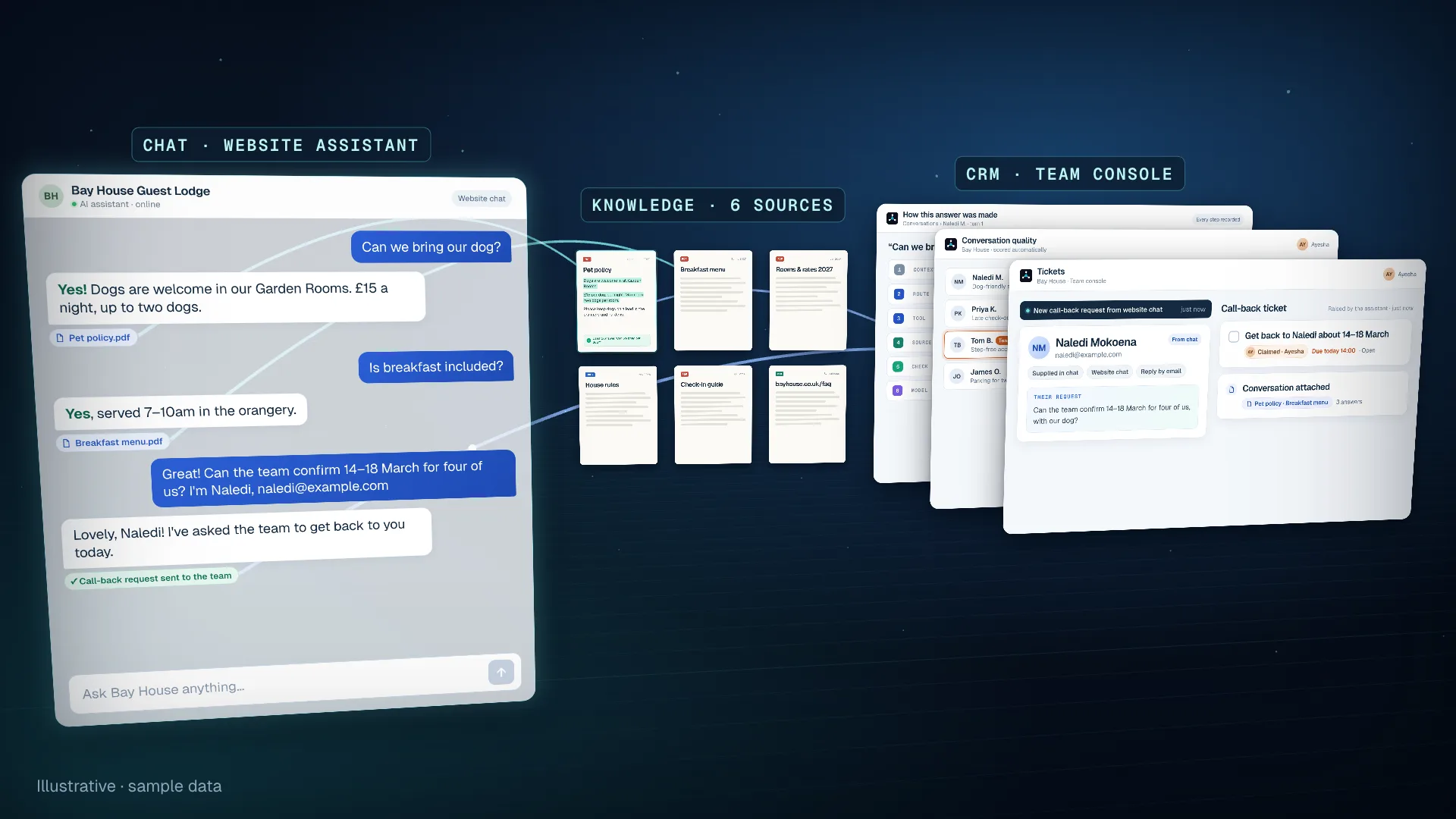
A narrated 58-second film with captions, using a fictional guest lodge and sample data. A visitor asks the website assistant whether they can bring their dog and gets an answer that names its source. The film then shows how the answer was found by meaning and by keyword, checked before it was sent, and traced step by step. The visitor’s booking request becomes a call-back ticket in the CRM that a team member claims. Conversations are scored, a low score alerts the team, and a team member takes that conversation over. It ends on Chat, Knowledge and CRM.
Try it for yourself
Ask Software Station AI.
Explore the platform, estimate costs, or tell us about your business.
In production
A South African tour operator runs its travel-agent concierge on Software Station AI, helping its trade partners with quotes, availability and bookings for Indian Ocean resort holidays.
The platform
Three parts. One connected business.
Start with the part you need. Your conversations, knowledge and customer records work together as you grow.
Where businesses start
- Answer enquiries outside office hours
- Help customers choose before a sale
- Find answers in policies and price lists
- Pass requests to the right person
Chat
Conversations that know where they’re going. And when to hand over.
An orchestrator reads each message and hands it to the specialist built for it — bookings, knowledge, or your own team. Every turn records its route, its tools, how long it took and what it cost.
Follow one message through the platform
Illustrative — a made-up guest lodge
- RouteAccommodation enquiry → Bookings specialist
- LookupKnowledge search: Rooms & rates 2026, p.2 · Seasonal rates
- Sureness91 of 100, against this business’s bar of 75
Answered, with its sources
Names the Garden Family Suite, says which season applies, and offers to have the team confirm. It claims no booking it has not made.
One assistant. Every door.
Each channel is a doorway into the same business: one set of agents, one knowledge base, one record of every conversation.
Website chat
Meet visitors on your website, with a conversation they can return to after a reload.
WhatsApp
Conversations over the WhatsApp Business platform, with documents sent on request and approved templates for the reminders a customer asked for.
Telegram
Each business can have its own bot. A website conversation can carry on there with its recent turns, and your team can reply in it.
Email
Mail to your business address becomes a ticket your team answers, threaded back to the person who wrote.
A person is one step away.
Takeover on website chat and Telegram
01
The customer asks for a person
The platform recognises it and answers in its own words — the agent cannot talk its way past the request.
02
Your team is told at once
By email, with no customer words in it, and on the desktop if they choose. The customer hears how long the wait is.
03
Someone takes the seat
The first to take it serves. They reply on the customer’s own channel, named as a person from your business.
04
And hands it back
The assistant resumes with the whole conversation. Nobody gains or loses a permission in the handover.
Conversation analytics
Read every conversation. Then make the next one better.
Inspect the conversation, see the tools it used, and review the quality findings. Use what you learn to improve the next answer.
Illustrative conversation and analytics — synthetic example
A family enquiry, from first question to handover.
Bay House Guest Lodge is a made-up business, written to show the shape of a real conversation and the analytics behind it. Inspect any reply to see what was traced, and what we have annotated.
Nothing on this panel is sent anywhere, and the live assistant did not write it. The real assistant is at the top of this page.
Bay House Guest Lodge — enquiry
Synthetic transcript
Customer
Hi — we’re two adults and two children, six and nine, looking at 14–18 March, four nights. What would work for us?
Customer
One of the grandparents may join us. Is there a room with step-free access, and is its bathroom step-free too?
Customer
And can you arrange a pickup from the airport?
Customer
Thanks. Back to the rooms — can both children share with us, or do we need a second room?
Customer
Perfect — please hold the Garden Family Suite for 14–18 March.
Turn 1 of 5 — Opening enquiry
Synthetic example
Customer asked
Hi — we’re two adults and two children, six and nine, looking at 14–18 March, four nights. What would work for us?
The assistant replied
For 14–18 March the Garden Family Suite is our usual choice for a family of four: two bedrooms off a shared lounge. Those nights fall in shoulder season, so the shoulder rates apply. Shall I check whether the suite is open for 14–18 March?
Recorded trace
- Route
- Accommodation enquiry
- Tools
- Knowledge search — rooms, seasonal rates
- Duration
- 2.4s
- Cost
- $0.004
The trace holds the route the turn took, the tools it used, how long it took and what it cost. Every value here is invented for the example.
Our annotations
The trace does not keep extracts of what an answer read, and quality findings are written for the conversation as a whole. Pinning them to one reply is how we explain the example, not something the product does for you.
Where this answer would come from
Rooms and rates
Garden Family Suite — two bedrooms off a shared lounge, sleeps four.
Seasonal rates
Shoulder season runs through March.
Working well — Resolution
Named a specific room for the dates given and offered the next step, instead of asking the family to describe their trip a second time.
Conversation quality — illustrative example values
Scored
Quality is judged across the conversation, not reply by reply. Which exchange we point at for each dimension is our annotation.
- Resolution
One gap
Did the customer get what they came for?
We point at turn 1 for this
- Brand compliance
Clear
Did it stay inside what this business allows?
- Tone
Clear
Did it sound like this business?
- Efficiency
Clear
Did it get there without wasting the customer’s time?
- Routing and tools
Clear
Did it take the right route, and hand over when it had to?
One finding, one improvement
A gap in the answer is a gap you can close.
On turn 2 the customer asked two questions and got one answer. Spotting that is the easy part. Turning it into a better answer takes a person who can check the library and the property.
01
Start from the question that went unanswered
The bathroom half of that reply got nothing back. It is there in the conversation for anyone to read, and it is specific enough to act on.
02
A person checks the library
Someone at the lodge looks up what the accessibility page actually says, establishes what that bathroom is really like, writes it down, and decides whether it goes into the answers customers see.
03
Check that it helped
Ask the question again, or read the next conversations that raise accessibility, and judge for yourself whether the answer improved.
Improvement is a decision your people make. Corrections do not publish themselves, and no assistant can promise never to fall short again — which is why the conversations stay readable and the findings keep coming.
CRM
Every conversation leaves a record. Your team picks it up from there.
When a conversation ends, your team gets a note of what the customer asked and what the assistant promised — each promise citing the turn it came from. People, requests, tasks and deals sit beside it, so nothing a customer asked for falls between the chat and the follow-up.
Conversation note · Naledi Mokoena
Illustrative
Asked for a family room for two adults and two children, 14–18 March, and whether a step-free room is available for a grandparent.
What the assistant promised
- The team will confirm the Garden Family Suite for 14–18 March.turn 5
- Airport transfer can be arranged once flight times are known.turn 3
Details the customer gave — waiting for a person
- Phone: +27 82 555 0143
- Prefers: WhatsApp after 17:00
Proposed next actions
Nothing here is written to the customer’s record, and no task exists, until a person chooses it.
People and companies
Relationship stage, owner, tags and fields you define. A matching email is only a clue: linking two records is a recorded act, never an automatic merge.
Requests and tasks
Call-backs, emails and handovers become requests with an owner, and a due time counted in your own business hours.
Deals, if you want them
New, qualified, proposal, negotiation — then won or lost, with a reason.
Reports counted from the records
Work, quality and usage: what arrived, what is overdue, how long it took, and what it cost.
Permission before contact
Your business writes first only with the customer’s recorded permission, checked before every send. Every email carries a one-click withdrawal.
Import and export
A CSV import that previews before it writes anything, and a complete export archive.
Or keep your own CRM
Connect the system your team already uses. Explore the integration options below.
Knowledge
Your documents, made answerable. Sourced, dated, and honest about gaps.
Give your team and your assistants one source for policies, product information and the questions customers actually ask. When a customer asks about your cancellation terms, the answer comes from the page your team maintains — and you can see which page that was.
- 01
Bring it in
PDF, Word, Excel, CSV, text and JPEG images — or a web page captured from its link, pictures included.
- 02
Read it properly
A PDF’s own text is trusted only when OCR agrees with it. Tables are rebuilt only when every cell traces back to the page.
- 03
Make it findable
Kept page by page, summarised, tagged, and indexed both for meaning and for the exact words customers use.
- 04
Publish deliberately
Everything starts as a Draft. Live is a decision a person makes, and every decision is on the record.
- 05
Keep it current
Versions carry the dates they apply to. Expired material stops answering, and its likely expiry is read from the document.
- 06
Close the gaps
Questions it could not answer wait for a person, and what they write can become a Draft for the next customer.
Illustrative — made-up questions and grades
Set the bar. Watch what clears it.
Every knowledge answer is graded three ways, each out of 100, and its sureness is the weakest of the three. Below your bar the answer is withheld rather than guessed, and the question can wait for your team instead.
The bar is your business’s own. Each change is a new version, recorded with who made it and why.
“What time is check-in?”
Answered · 93
- What it found is relevant
- 97
- It covers the whole question
- 95
- It needs little guesswork
- 93
Answers from Arrival guide.pdf · p.1, and names it.
“Is the Courtyard Twin’s bathroom step-free?”
Sent to a person · 62
- What it found is relevant
- 90
- It covers the whole question
- 62
- It needs little guesswork
- 70
The page covers the room, not its bathroom. The customer hears that a person will follow up, and the question waits in your team’s review queue.
“Can we bring our dog?”
Sent to a person · 12
- What it found is relevant
- 31
- It covers the whole question
- 12
- It needs little guesswork
- 20
Nothing in the library mentions pets. The customer hears that a person will follow up, and the question waits in your team’s review queue.
Indexify
Knowledge on its own, for technical teams.
Indexify is the name of our Knowledge functionality offered on its own to technical teams who want answers from their documents inside their own software. Their applications ask through the knowledge API, and their team's Claude or Codex asks through MCP.
indexify.aiBuild
Make it yours. Put it anywhere.
The website chat takes your colours, type and shape, and drops into any page with one script tag. Behind it, your records and your knowledge are reachable from the software you already run.
Try the controls
A handful of the widget’s brand controls. Your administrators set the rest — eight colours, type size, spacing and panel size — with a live preview that warns when text gets hard to read.
<div id="chat"></div>
<script src="https://softwarestation.ai/plugin/swarm-plugin.umd.js"></script>
<script>
  SwarmPlugin.renderChat('chat', {
    tenantId: 'your-business',
    apiKey: 'YOUR_CHAT_KEY',
    apiUrl: 'https://softwarestation.ai',
    presentation: "floating",
    appearance: {
      title: "Bay House",
      primaryColor: "#0e7490",
      fontFamily: "ui-sans-serif, system-ui, -apple-system, sans-serif",
      cornerRadius: 16,
    },
  });
</script>
Website widget
One script, isolated from your page’s styles. Your page can open it from its own buttons, and move it between inline and floating as visitors scroll.
Knowledge query API
Ask your published knowledge from your own software, scoped to a knowledge base and a date, and get the sources and confidence back with the answer.
CRM API and webhooks
People, companies, tasks, activities and deals over a versioned API, with signed change events your systems can trust.
Knowledge over MCP
Connect a business’s knowledge to AI assistants such as Claude and Codex, with sign-in and an access log on every call.
Read the connection guideConversation API
Let a partner’s system hold a conversation with your assistant, with its own key and its own limits.
Keys with one job
A key reaches customer records, or chat and knowledge — never both. It is shown once, and your administrators can revoke it.
Safeguards
Rules written into the platform. Not into the prompt.
An assistant is only as trustworthy as the system around it. These hold for every agent on Software Station AI, whatever it has been told.
Each business’s data is kept apart
Every lookup names the one business it is for. A missing or wrong business returns nothing — never everything.
Only approved versions answer customers
An agent with no published version refuses rather than falling back to a default. Versions never change once written.
Tests never change real records
Previews run in dry-run. An action with no safe simulation is blocked, not attempted.
No message can unlock an action
Each action is declared, granted on its own, and gated by your write mode. No message, however clever, opens it.
A known name is not proof of identity
A matching name, email or number is a clue, never proof of who someone is. Website visitors start as strangers.
Every important change is logged
Publishing, knowledge decisions, settings, record changes and AI-assistant access go into books that are only ever added to.
Customers can read their own conversation
A visitor can open a read-only record of their own conversation — and close the link when they are done.
Spending has a daily cap
A daily cap per business turns new work away with an honest answer, and never interrupts work already running.
Shipped like software.
An agent’s instructions, specialists and tools move through three spaces. Each crossing seals the version, so what is live can always be named.
- 1
Private
Drafted and diffed against what serves now. Every save is a new version.
- 2
Preview
Tried in dry-run against question banks and simulated customers.
- 3
Live
Published with a reason and its evidence. Rolled back in one step.
Tested before a customer sees it.
The same discipline a software team applies to code, applied to what an assistant says.
- Question banks with expected answers, graded by an AI judge
- Simulated customers holding multi-turn scenarios against the agent
- Questions that got worse between versions, flagged before release
- Scheduled runs, so drift shows up on its own
- New AI models must pass a business’s own bank before they serve it
- Every live conversation scored against the business’s own rubric
Pricing
Pay for what is used. Run the numbers.
Usage prices in US dollars. A knowledge query counts as one interaction. Enter your volumes or use the sliders to estimate usage. Setting up your business with us — routing, specialist agents, actions in your systems and WhatsApp — is quoted separately.
- Knowledge, per document$0.10
- Knowledge, per page$0.01
- Per agent interaction$0.05
An agent interaction is one message or one button click from a customer — not a whole conversation. A knowledge query, one question your software asks of your documents through the knowledge API or MCP, counts as one interaction too.
Knowledge for this library
$21.60
120 documents · 960 pages
Agent interactions, a month
$150.00
3,000 interactions × $0.05
An estimate of usage. Setup for your business is quoted separately, and we confirm both with you.
Getting started
Find the right starting point.
We help you choose the Software Station AI capabilities that fit your business and put them to work. If another approach would serve you better, we say so.
It starts with a free assessment: we review your website and send you a proposal within four working days.
Request an assessment- 01
Assess
Choose a business problem worth solving and agree what improvement would look like.
- 02
Pilot
Start with one real use case. Agree who reviews knowledge, approves behaviour and picks up escalations.
- 03
Measure
Review the conversations, unresolved questions and effort saved against your agreed measures.
- 04
Expand
Build on what earns its place. Leave what does not.
We handle the platform
Agent setup, system connections, document indexing, model testing, hosting and monitoring. We keep it running as your business changes.
You make the business decisions
What the assistant may do, which documents are live, how sure answers must be, and who follows up with customers.
FAQ
A few practical questions.
1.Do we need developers to use it?
No. We set up your business, build and look after your agents, and connect your systems. Your team works in the console — conversations, knowledge, customers and reports. If you have developers, the widget, APIs and webhooks let them go further.
2.What happens when it does not know?
It says so. Knowledge answers are graded, and below the bar your business sets, the answer is withheld rather than guessed. The question can wait for your team, and what they write can become a document for the next customer. Anyone who asks for a person is put in your team’s queue — or told plainly when nobody can reply, and offered a call-back.
3.Can it change things in our other systems?
Only through actions we build and grant one at a time, and only when your business’s write mode allows it. Previews always run in dry-run. Every action reports whether it was committed, refused or unknown, and an unknown outcome is never silently retried.
4.We already have a CRM. Do we need yours?
No. Smaller businesses can use the CRM built in; larger ones can keep their own and connect it through the CRM API and signed webhooks.
5.How is our data kept apart, and where does it live?
Every lookup and every action names the one business it is for, and a missing or wrong business returns nothing. Keys, roles and records are scoped to one business. Records and documents are stored in the EU, in AWS’s Ireland region; the AI model providers that generate answers process requests outside it.
6.What does it cost?
In US dollars: knowledge is $0.10 a document plus $0.01 a page, charged once per upload, and each agent interaction — one message or button click from a customer — is $0.05. A knowledge query, one question your software asks of your documents through the knowledge API or MCP, counts as one interaction too. The pricing calculator above shows what that means for you. Setting up your business with us — routing, specialist agents, actions in your systems and WhatsApp — is quoted separately.
Free assessment
Request an assessment.
We review your website and send you a proposal within four working days. Where we can, it comes with a working assistant built from your own site to try.
No cost and no commitment. We can’t take on every request; if we can’t help, we’ll tell you.
Rather not use the form? Ask the assistant or email us. However you reach us, we’ll reply within four working days.